A product I already bought, and a shelf with no history
I had been a customer for years before I took the seat. I knew what the product was and why people kept buying it before I knew the founders, and that is the whole reason I took the seat. It was not a retail buying prior. I had spent twenty years as a general contractor and developer, and nothing in that career had put me across a table from a grocery category manager. What I brought was belief in the product, a sales background from the trades, and a habit of asking what the person across the table is actually deciding.
The company in 2022 was two founders, one finance person, and a functional mushroom brand that had built a real direct-to-consumer following and wanted a national shelf. I came in as Seed Advisor, Go-to-Market, and stayed on as a growth advisor through 2026. The mandate was advisory. I never held an operating title, and every product and retail decision stayed the founders'.
The brand's own site is still the best picture of what it sells, a chocolate for each job a person wants done: alicemushrooms.com.
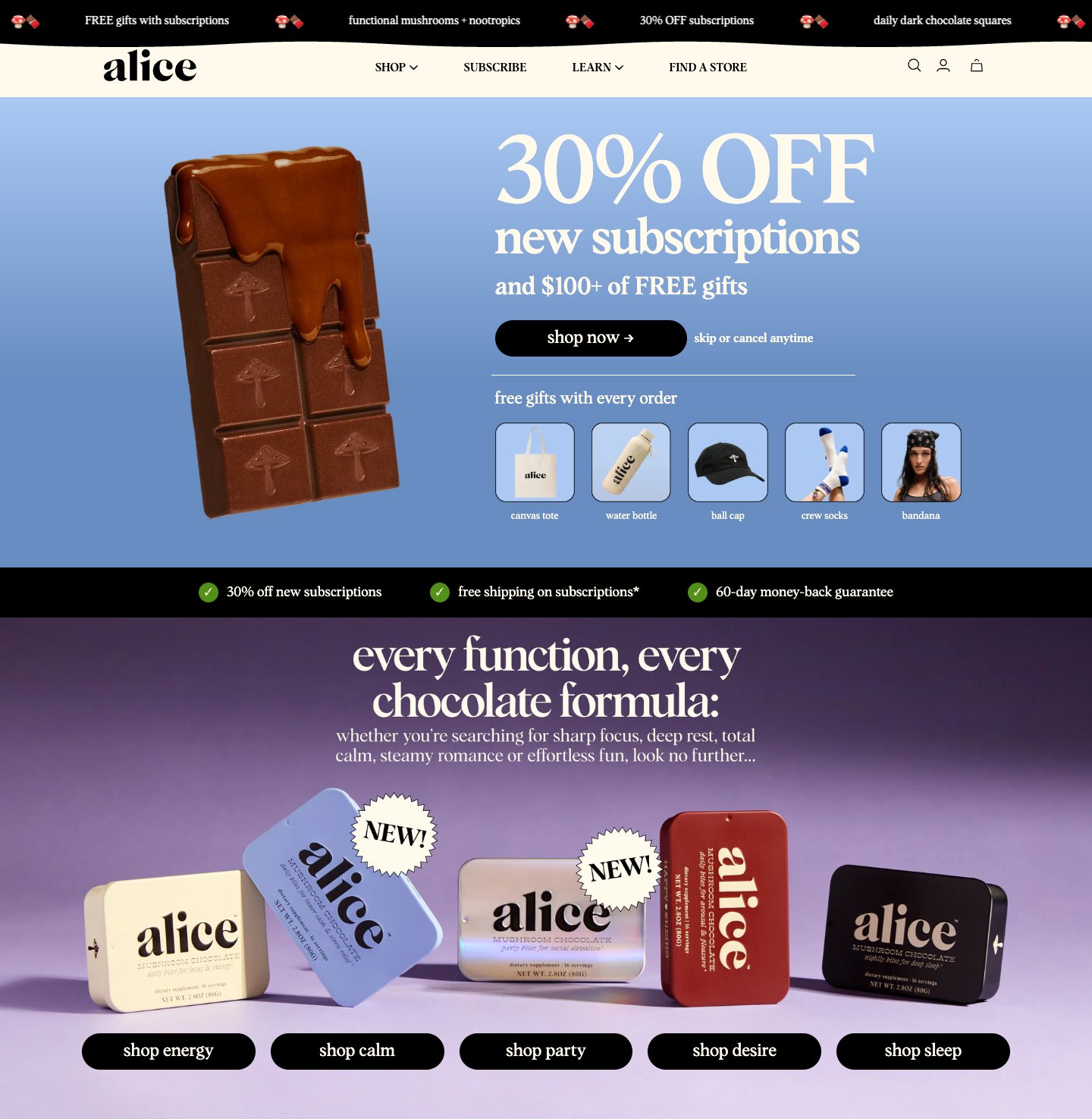
The people in this story are the two founders, who ran the brand and every buyer relationship; the finance person, who carried the numbers; the buyers and category managers at the chains, who are not named here; and me. What the company believed the problem was, going in, is what almost every founder-led brand believes: a strong product and a good founder story win the placement once the right buyer takes the meeting. That was my instinct too, and it was wrong in a specific way.
The category had never produced a national leader on a major grocery shelf. That sounds like an opportunity, and it is, but for a retail buyer it is a hole in the file. A buyer underwrites a placement against a sales history: the item's own, or the category's on their own shelves. A genuinely new category has neither. So the buyer is not deciding whether the product is good. The buyer is deciding whether to take on the work of justifying a bet with no data behind it, at their own internal category review, with their own name on it. Winning the meeting, not the pitch inside it, was the first problem to solve.
Do the buyer's homework for them
My first instinct in those early conversations was to lead with the product: the formulation, the sourcing, the consumer response. That is the ordinary default and I started there like anyone would. It does not work against this problem, because there is nothing yet for the buyer to check product merit against. A category with no shelf history gives the buyer no comparison, and a buyer with no comparison has no sentence to write down at their review.
The question I moved to was what this specific buyer already trusts. The answer was syndicated scan data, the same third-party category reporting most chains already subscribe to. A buyer who holds that subscription learns nothing from being told it exists. What changes the meeting is walking in having already run the cut for that buyer's own chain and that chain's own category hierarchy, showing the adjacent category, adaptogenic beverages and the functional wellness shelf, already growing in their own stores. Then the category-creation pitch reads as an extension of a trend the buyer's own numbers support rather than an isolated new bet. The buyer gets a citable figure to defend the placement at their review, and the analytical work they would have had to do themselves is already done.
That is an information gap, not a money gap or a time gap. The brand had no sell-through of its own because nobody in the category had ever sold through at national scale. The adjacent-category cut is the closest thing to evidence a buyer can trust before the brand has produced any of its own, and doing that work for them is what got the pitch taken seriously at all.
The second decision followed from the first. If the adjacent-category number opens the door where no item-level data exists, then the brand's own sell-through data at a national chain is the stronger evidence, and it is the evidence the next tier of buyers will ask for. So the advice was to weight the early effort toward the national chains, the highest-reach and highest-risk placements, rather than build a safer record at smaller accounts first. A new format failing at a national chain with no fallback comparable is a real delisting risk, and I did not argue it away. The adjacent-category evidence made the bet arguable to the buyer. It did not make the bet safe.
How I came at this one
The first question was what this buyer already trusts, and what they answer for, since a category manager is measured on velocity and write-downs and has no history for a new category on either. That question fit because the founders had a product people loved and a buyer with nothing to check it against. The second question was what offer makes the buyer's job easier, and the answer was their own homework, already done.
When I came in I thought I knew what kind of company this was. The founders knew better, and they did not need me to agree. They needed the buyer's homework done, and then they needed me to get out of the way.