The order it went, as an evolution and not a single room
None of this happened in one meeting. The retail interest built slowly, the founders kept winning stores, and the reasoning below is the order the decisions came in, not a script that was run.
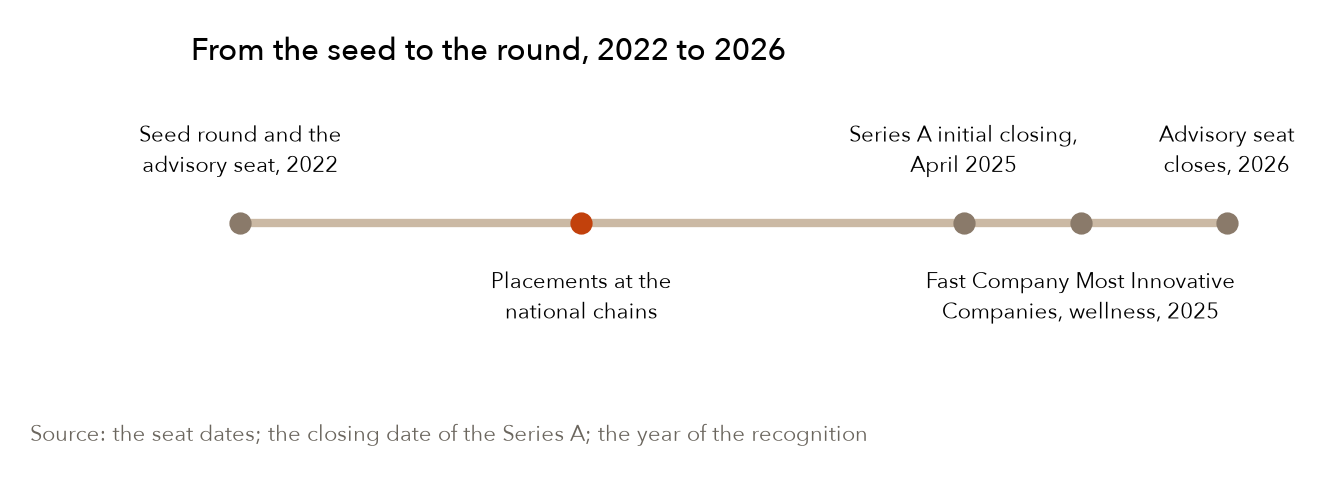
- Take the seat on a thesis that could be wrong. Known: the product, from years of buying it. Not known: whether the founders had a particular, arguable reason this brand would win the category, rather than enthusiasm for the space, and whether the category itself was growing enough in adjacent data to support a national winner at all. I asked those two questions together, as one gate, because a right thesis in a category that will not grow does not clear it either, and a wrong thesis cannot be fixed by better execution later. The third input was the direct-to-consumer response: repeat purchase and reviews that a retail buyer would eventually be shown, so they had to exist and be real before any retail conversation started. All three held, and the same three lines became what I asked the founders for in every update afterward.
- Name the gate. Known: the pitch was product-led and the buyers were polite. The question was what the buyer was actually deciding, and the answer was whether to originate trust in a category with no history at their own review. That reframed the problem from persuasion to evidence. It changed what we brought to the meeting and who did the analytical work before it.
- Cut the data for that buyer. Known: the adjacent category was growing, and most chains already subscribed to the data that showed it. The question was which cut a specific buyer could carry into their own review, and the answer was their own chain, their own category hierarchy, the category closest to where this product would be shelved or cross-merchandised. It produced a number the buyer could write down. It changed the pitch from an argument about the product to a piece of the buyer's own work, finished.
- National chains first. Known: a national chain placement is the highest-risk retail move a new format can make. The question was what a national win produces that a smaller one does not, and the answer was the brand's own syndicated sell-through, which is what every later buyer asks for. The tier map in Attachment B is where the advisory hours went by tier, and it is a sequencing rule rather than a ranking of which doors are worth more per unit. It changed the order of the calendar.
- Move the proof down the tiers before someone else's data does. Known: a national placement is a single event; the next conversation at a regional chain runs on the sell-through that placement generates, and syndicated data reports on a delay. The question was whether the company captured a new win and repackaged it for the next buyer as soon as the data existed, or whether that depended on someone remembering. It is the reason the advisor update in Attachment A carries a pipeline line beside the door count; Attachment B is the tier model as a one-page tool.
- Build the fundraising story on the same evidence. Known: an institutional round underwrites a growth thesis, not a product. The question was whether the story that had moved buyers would move the people writing checks, and the answer was to lead with the retail proof, category position at the national chains and door growth, before the product story. I sequenced it that way. What the round actually responded to is not something an advisor can observe from the outside, and I do not claim it.
- Let the founders pivot. Known: the retail placements kept coming, and the company was becoming something bigger on the shelf than any of us had planned for. The question was whether my read of the company or the founders' read was the one to back, and the answer was theirs. The brand became the business, and the founders turned out to be world-class marketers and storytellers. The founders took every piece of advice in stride, and the one decision that mattered most was one I did not make: I stopped arguing for the company I had thought it was and backed the one it was becoming. The question that stays is which parts of the company are the product, and what gets subtracted.
What it produced
The result on the cover is the one figure a reader could check. It is the company's number, built by its founders and their team; my part ran alongside it. It also does not sit entirely inside the two chains named on the cover. A category rank at two national chains is a statement about rank, and the door count is a statement about breadth, and the chains' own published store counts show that the second cannot be explained by the first alone.
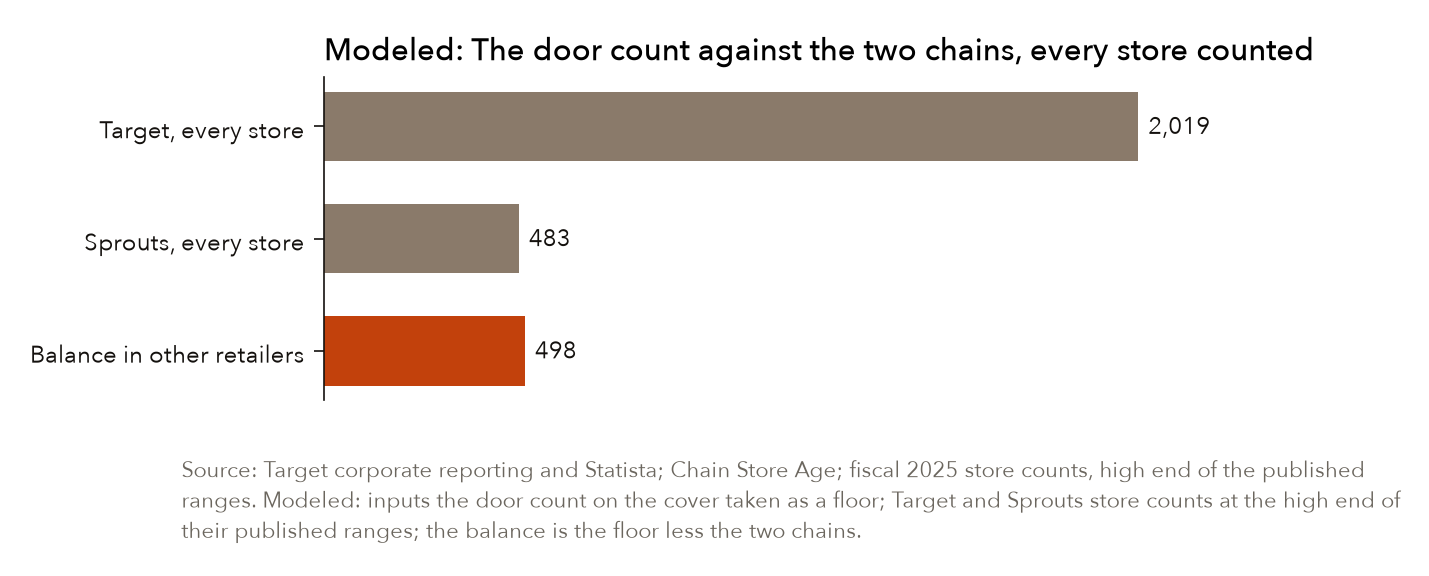
I ran that arithmetic myself rather than let the two chain names carry a number they cannot. A buyer at a regional chain will run it too. That balance is the regional and specialty tiers in the tier map, and it is where the proof from the national chains went to work.
The round came on the same evidence. The company closed an oversubscribed Series A led by NewBound, with Unilever Ventures writing the largest check in the round, and the year the round closed the company was on the Fast Company list drawn on the strip above. The recognition and the round are the company's. What I can say about the advisory part is narrower and, I think, more useful: the same three lines, the founders' thesis, the category's own growth, and the consumer response, opened the retail door and carried the fundraising story, and I never had to build a second argument for a second audience.
| What the buyer had | What we walked in with | What it let the buyer do |
|---|---|---|
| No sales history for the category on their own shelves | The adjacent category's growth, cut for their own chain and their own hierarchy | Write down a number at their internal review that their own data already supported |
| A subscription to the same syndicated data | The specific cut already run | Skip the analytical work that would otherwise have sat between the meeting and a yes |
| A rule that new formats get cut at the next review if they do not move | A national placement first, so the brand's own sell-through existed before the next tier asked | Underwrite the regional placement on the brand's own numbers rather than a proxy |
What we kept, replaced and installed
We kept the founders' direct-to-consumer engine. It was never a lower-priority channel; it was the input that produced the consumer response every retail buyer was eventually shown, and I said so whenever the retail calendar threatened to pull attention from it. We kept every product decision where it belonged, with the founders, and when their read of the company outran mine, we kept theirs.
We replaced the product-led pitch. The founders put it in, and I would have too, because it is what a founder-led brand has the most of and it is the natural thing to lead with. The fault in its logic is that it assumes merit wins the meeting, and a buyer with no category history has nothing to check merit against, so the merit never reaches the decision. It had to change in the first retail season rather than later because a seed-stage brand gets one shot at each national buyer's calendar per season, and a pitch that does not land is a season lost.
We installed two things. The first is the door-tiering model in Attachment B, a sequencing rule for where the evidence comes from and where it goes next. The second is the advisor update, which is what I asked the founders for and why.
What I ask a seed-stage company for, and why
- Door count and category position, by chain. It is the growth line the whole go-to-market was built around, and it moves faster than revenue.
- New wins and the pipeline behind them. A national win only matters if the next tier hears about it before the syndicated data ages.
- The consumer response from the direct channel: repeat purchase and reviews. It is the evidence the next buyer will be shown.
- Fundraising status, as events occur rather than on a calendar.
- Financial detail to the cap table only, never into anything with a wider audience.
The logic that had to change: a founder writes an update to report progress. An advisor reads one to find the next buyer's evidence before it goes stale. Attachment A is the template.
What it cost to hold the line, and what I would watch
It cost the differentiation pitch. Buyers sometimes want to hear what makes the product special, and this method asks them to hear about their own numbers first. It structurally underserves a genuinely novel attribute with no adjacent trend to anchor to, because the whole method depends on a comparable already growing in the buyer's own data.
It cost the safe route. Going to the national chains first accepted a real delisting risk with no fallback comparable, and the adjacent-category evidence made the bet arguable rather than safe. And it cost me my thesis. I came in with a picture of the company, and the founders built a better one, and backing theirs meant letting go of mine in front of people I had been advising to do the opposite.
The method also expires. It is the best logic available until the brand has its own sell-through, and the moment it does, the adjacent-category number is a proxy and the brand's own numbers are the real thing. The characteristic mistake of someone who has just learned a pattern is running it past where it applies, and I watched for that in myself as much as in the sales process.
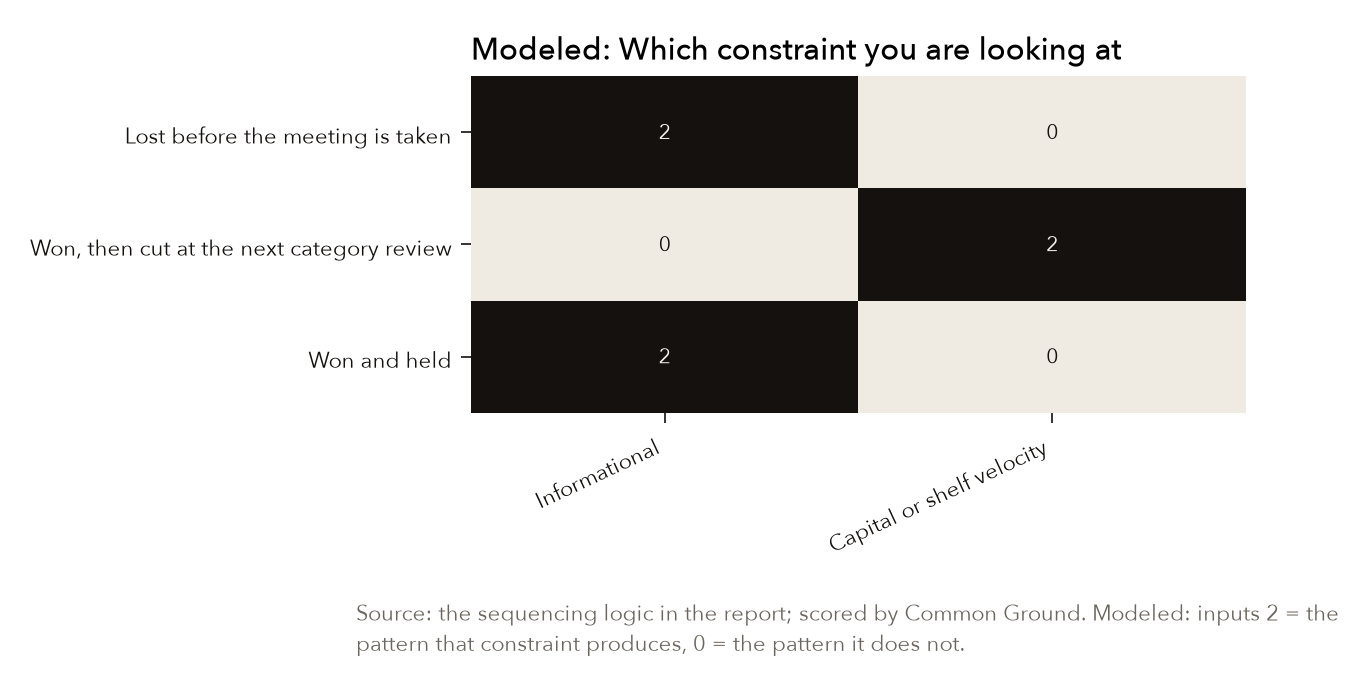
What I would watch, on any brand selling a new category into an established buying process:
- Where the placements are lost. Before the meeting means the buyer could not justify the bet; fix the evidence. After the review means the item did not move; fix the product, the price or the promotion, and stop polishing the pitch.
- The lag between a win and its use. Syndicated data reports on a delay. The next buyer should hear about the national win from the company before the data catches up, and that is a process, not a hope.
- The hand-off between tiers. A national win that never reaches the regional buyer's desk is a win the company paid for and did not collect on.
- The day the proxy expires. When the brand's own sell-through exists, lead with it. Leading with someone else's data past that point tells a buyer you have not looked at your own.
- Whose read of the company is right. The founders' read outran mine, and the company is better for it. An advisor who cannot be talked out of the company he thought he had joined is a cost, not a check.
The result, in short
3,000-plus retail doors, and the number one item in its category at both Sprouts and Target, reached as the brand moved from direct-to-consumer into national grocery and mass retail. The company closed an oversubscribed Series A led by NewBound, with Unilever Ventures writing the largest check in the round, and made Fast Company's Most Innovative Companies list in wellness in 2025. The door count and the round are the company's; the advisory work opened the buyer conversations that made the national placements possible.
A slice of the project list
A few related projects.
- Drive for the Dream: creator, a golf docuseries venture, signed cast and producers before any platform ask (2023 to 2025)
- Contractor Gorilla: search strategy and an advisor seat with equity in the agency (2014 to 2017)
- Ink Games: Seed Advisor, Go-to-Market, and the seed raise through Prince Capital (2019 to 2020)
- Aycre Capital: fund formation and capital raise process, Managing Director (2022 to 2023)